Readings: Cryptography Summary
Introduction to Cryptography
-
Cryptography requires two steps: encryption and decryption. The encryption process uses a cipher in order to encrypt plaintext and turn it into ciphertext. Decryption, on the other hand, applies that same cipher to turn the ciphertext back into plaintext.
- Encryption: scrambling the data according to a secret key (in this case, the alphabet shift).
- Decryption : recovering the original data from scrambled data by using the secret key.
-
Code cracking : uncovering the original data without knowing the secret, by using a variety of clever techniques.
- Types of Cryptography :
- Hashing : Hashing is a type of cryptography that changes a message into an unreadable string of text for the purpose of verifying the message’s contents, not hiding the message itself.
- Symmetric Cryptography: This type of cryptography uses a single key to encrypt a message and then decrypt that message upon delivery.
- Asymmetric Cryptography :Asymmetric cryptography (as the name suggests) uses two different keys for encryption and decryption, as opposed to the single key used in symmetric cryptography. The first key is a public key used to encrypt a message, and the second is a private key which is used to decrypt them.
- Key Exchange Algorithms
- The 4 Types of Cryptographic Functions :
- Authentication
- Nonrepudiation
- Confidentiality
- Integrity: The most common way to do accomplish data integrity through cryptography is by using cryptographic hashes to safeguard information with a secure checksum.
Ceasar Cipher :
-
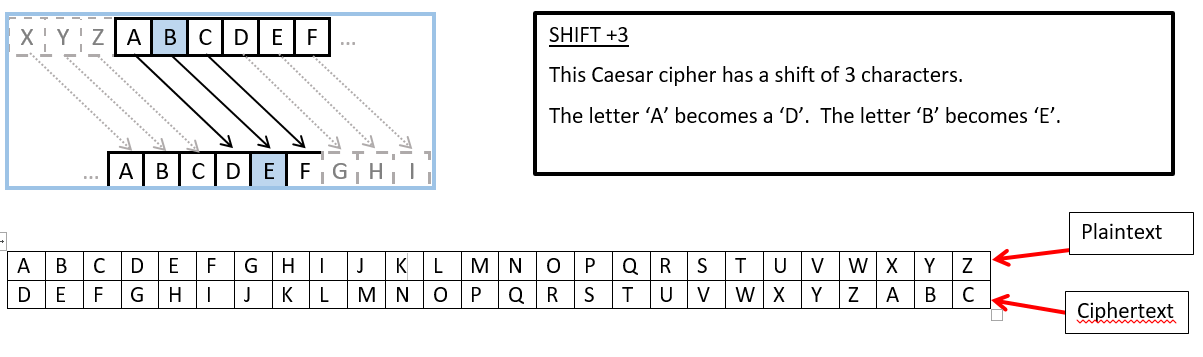
In cryptography, a Caesar cipher, also known as Caesar’s cipher, the shift cipher, Caesar’s code or Caesar shift, is one of the simplest and most widely known encryption techniques. It is a type of substitution cipher in which each letter in the plaintext is replaced by a letter some fixed number of positions down the alphabet.
- The Caesar cipher can be easily broken even in a ciphertext-only scenario. Two situations can be considered:
- an attacker knows (or guesses) that some sort of simple substitution cipher has been used, but not specifically that it is a Caesar scheme;
- an attacker knows that a Caesar cipher is in use, but does not know the shift value.
- Example :