Read: Class 01 Summary:
Pain vs. Suffering :
- Pain is a normal, built-in part of life on earth but what is avoidable, though, is suffering. All it takes is practice.
A beginner’s guide to Big O Notation :
-
Big O notation: is used in Computer Science to describe the performance or complexity of an algorithm. Big O specifically describes the worst-case scenario, and can be used to describe the execution time required or the space used (e.g. in memory or on disk) by an algorithm.
- Examples :
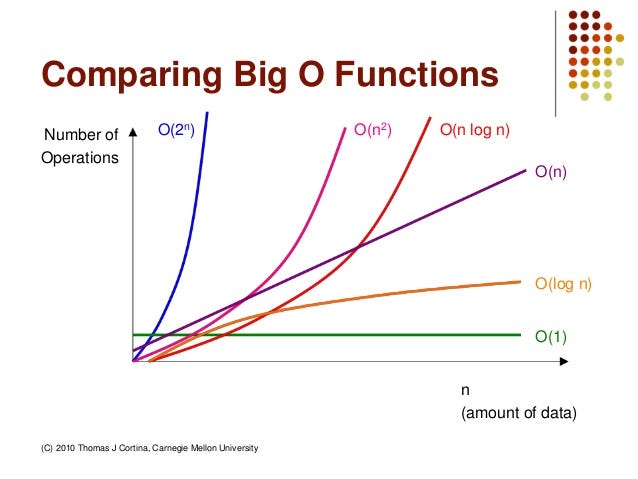
- O(1) algorithm describes an algorithm that will always execute in the same time (or space) regardless of the size of the input data set.
bool IsFirstElementNull(IList<String> elements) { return elements[0] == null; } - O(N) algorithm :describes an algorithm whose performance will grow linearly and in direct proportion to the size of the input data set.
- O(1) algorithm describes an algorithm that will always execute in the same time (or space) regardless of the size of the input data set.
bool ContainsValue(IEnumerable<string> elements, string value)
{
    foreach (var element in elements)
    {
        if (element == value) return true;
    }
    return false;
}
- O(N²) algorithm represents an algorithm whose performance is directly proportional to the square of the size of the input data set. This is common with algorithms that involve nested iterations over the data set. Deeper nested iterations will result in O(N³), O(N⁴) etc.
bool ContainsDuplicates(IList<string> elements)
{
    for (var outer = 0; outer < elements.Count; outer++)
    {
        for (var inner = 0; inner < elements.Count; inner++)
        {
            // Don't compare with self
            if (outer == inner) continue;

            if (elements[outer] == elements[inner]) return true;
        }
    }
    return false;
}
- O(2^N) algorithm denotes an algorithm whose growth doubles with each addition to the input data set. The growth curve of an O(2^N) function is exponential — starting off very shallow, then rising meteorically. An example of an O(2^N) function is the recursive calculation of Fibonacci numbers.
int Fibonacci(int number)
{
    if (number <= 1) return number;

    return Fibonacci(number - 2) + Fibonacci(number - 1);
}
- O(log n) algorithm :This notation means that the runtime complexity of your algorithm will be increased by one when the size of input data is doubled.
Facts and Myths about Names and Values:
- Names refer to Values and the assignment is making the name refer to that value.
- Many names can refer to one value
- Names are reassigned independently.
- Values live until no references .
- Assignment never copies data and changes are visible through all names.
- Mutable aliasing but Immutable values can’t alias.
- Immutable values includes ints ,float ,strings,tuples.
- Changing ints : rebinding ,Changing a list :mutating .
- We can rebind lists like this : num=num+[7]
- We can’t mutate an int because int is immutable .
- Mutable and Immutable are assigned the same so assignment is the same for all values but the aliasing can make it seem different .
- References can be more than just names like list elements,object attributes,dict values and keys,function arguments ,and anything in the left side of an assignment.
- for loops :
for x in sequence: something(x) - Names have no type and values have no scope
How to Setup an Awesome Python Environment for Data Science or Anything Else:
- Coding in Python is awesome due to the massive amount of freely available libraries, its readability, and the recently introduced type annotations.
- Pyenv is a set of three tools , two of them are pyenv (used to install python) and pyenv-virtualenv (used to configure your global tools).
- Mypy is a static type checker for python code, that finds errors before they appear.
- Pre-commit is a tool that executes checks before you commit code to your repository.